Processors/Comparison
15 specifications
Intel Core i7-14700 vs AMD Ryzen 9 9950X
On paper, the Intel Core i7-14700 has more cores (20 against 16), the AMD Ryzen 9 9950X boosts higher, and the AMD Ryzen 9 9950X carries more L3 cache. Specifications describe what each chip is designed to do; how much of that either one holds under continuous load is a separate question.
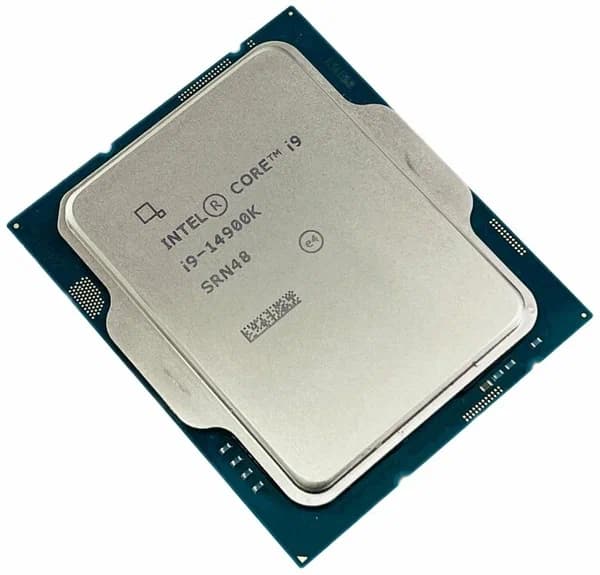
Intel Core i7-14700
Intel · Raptor Lake Refresh (14th gen) · Desktop
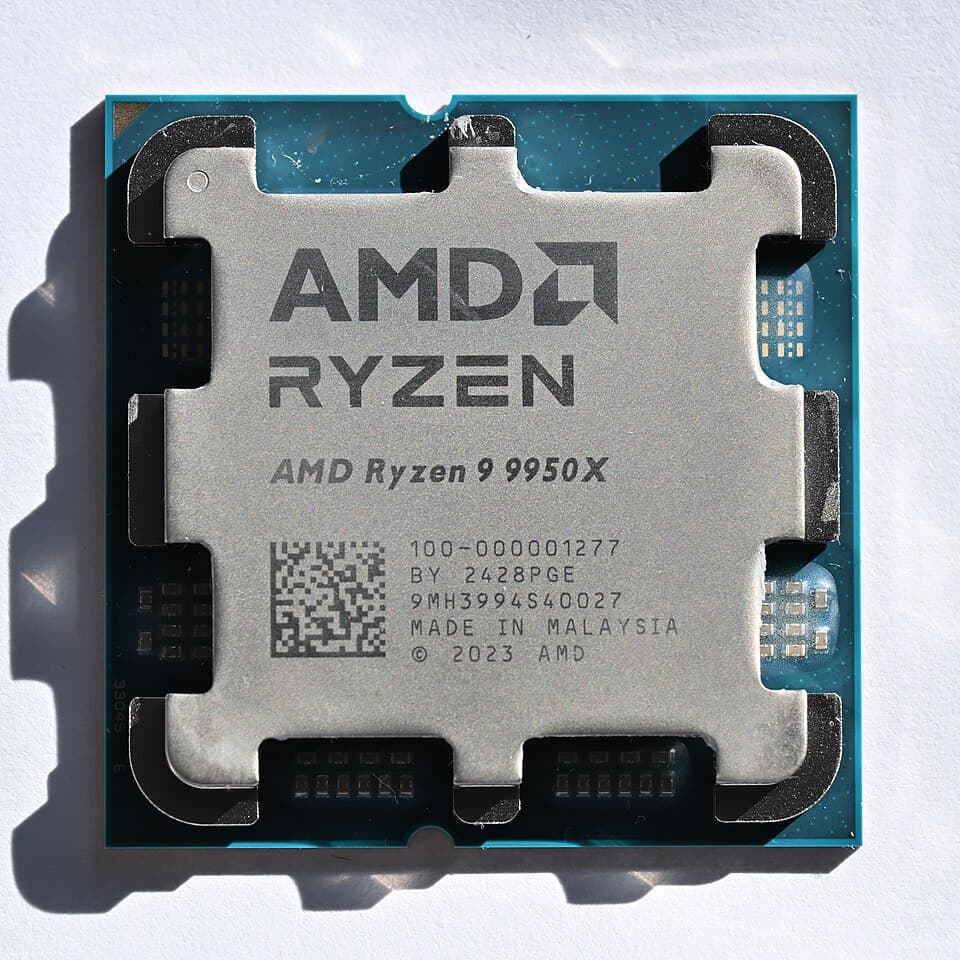
AMD Ryzen 9 9950X
AMD · Ryzen 9000 (Granite Ridge, Zen 5) · Desktop
Cores and clocks
Cache and power
Platform
A check marks the higher figure only on rows where higher is unambiguously better. Rows without one are not ties; they are specifications where “better” has no meaning.
Reading the table
What the difference means.
Cores and threads
This pair splits: the Core i7-14700 has more cores (20 against 16) while the Ryzen 9 9950X runs more threads (32 against 28). That happens when one design runs two threads on every core and the other does not, or mixes large and small cores. A second thread on a core adds roughly a quarter to a third of a core's work, not a whole one, so 20 full cores and 32 threads on 16 cores land closer together than either number suggests. Work that spreads across everything, such as rendering, compiling and video export, is where the difference shows; which side wins it depends on how fast each core is, which a specification sheet does not say.
Boost clock
The Ryzen 9 9950X boosts to 5.7 GHz against 5.4 GHz, 6 percent higher. Across generations it is not a guide to speed on its own, for the reason above. Boost is also a peak: it is held for seconds to minutes, on one or two cores, while the cooling and the power limit allow. What either chip settles at under a long load is lower, and it depends on the cooler and the motherboard as much as the chip.
Cache
The Ryzen 9 9950X carries 64 MB of L3 cache against 33 MB. Cache is fast memory on the chip, and a larger one means the cores wait on main memory less often. Games, large spreadsheets and compiling respond to it; rendering and video export, which stream through data in order, respond much less.
Power and cooling
The Ryzen 9 9950X is rated at 170 W against 65 W. The rating is the heat the cooler has to move for the chip to hold its speed, and modern chips draw well above it in short bursts. A tower cooler or a liquid loop suits the Ryzen 9 9950X; the Core i7-14700 is easier to keep quiet and fits smaller cases. A chip whose cooling falls short does not fail. It slows down, and it does so after the first minute, which is why short benchmarks miss it.
Platform
They use different sockets, FCLGA1700 and AM5, so moving from one to the other means a new motherboard, and new memory as well: FCLGA1700 takes DDR4 or DDR5, depending on the motherboard, AM5 takes DDR5. For an upgrade, that cost belongs in the comparison; for a new build, the newer platform is the one with later chips still to come.
Which to pick, on paper
- Rendering, compiling, video export
- Ryzen 9 9950X
- 32 threads against 28. Work that uses every thread scales with how many there are.
- A quiet or compact build
- Core i7-14700
- 65 W against 170 W: less heat to move, so a smaller cooler and slower fans.
What no table says
How much of its speed a processor keeps after the first minute depends on the cooling and the power limit of the machine it is in. If you own one of these, measure it: the test is free and runs in this browser.
Questions
- Is the Core i7-14700 better than the Ryzen 9 9950X?
- By need, on the specifications: rendering, compiling, video export: the Ryzen 9 9950X; a quiet or compact build: the Core i7-14700. No specification says how much speed either one keeps under a long load; that depends on the cooling and the power limit of the machine it is in, and it is what a sustained test measures.
- Do the Core i7-14700 and the Ryzen 9 9950X use the same socket?
- No. The Core i7-14700 uses FCLGA1700 and the Ryzen 9 9950X uses AM5, so switching means a new motherboard and new memory.
- Does the Core i7-14700 or the Ryzen 9 9950X have integrated graphics?
- Both do: Intel UHD Graphics 770 on the Core i7-14700 and AMD Radeon Graphics (RDNA 2, 2 CU, 2.2 GHz boost) on the Ryzen 9 9950X.
- Which runs hotter, the Core i7-14700 or the Ryzen 9 9950X?
- The Ryzen 9 9950X is rated at 170 W against 65 W, so it produces more heat under load and needs the larger cooler. How hot either one actually runs depends on the cooler and the case more than on the chip.
More comparisons
- Intel Core i7-14700 vs Intel Core i7-14700F
- Intel Core i7-14700 vs Intel Core Ultra 7 265K
- Intel Core i7-14700 vs Intel Core Ultra 7 265KF
- Intel Core i7-14700 vs Intel Core Ultra 7 265
- Intel Core i7-14700 vs Intel Core Ultra 7 265F
- Intel Core i7-14700 vs Intel Core i7-14700K
- AMD Ryzen 9 9950X vs AMD Ryzen 9 7950X
- AMD Ryzen 9 9950X vs AMD Ryzen 9 9900X3D
- AMD Ryzen 9 9950X vs Intel Core Ultra 5 250K Plus
- AMD Ryzen 9 9950X vs Intel Core Ultra 7 265
- AMD Ryzen 9 9950X vs Intel Core Ultra 7 265F
Every figure on this table is a design target. None of it is a measurement.
Nothing above describes how a processor behaves twenty minutes into a sustained workload, which is where two chips with nearly identical specifications routinely diverge. A boost clock is a ceiling the vendor permits, not a rate the chip sustains, and whether it holds depends on the cooling, the case, the power profile and the room. None of those appear on a specification sheet.
We deliberately do not reduce these figures to a single score. A composite invented from specifications would look authoritative and measure nothing, and choosing the weights would be choosing the winner.