Processors/Comparison
15 specifications
Intel Core i5-12400 vs Intel Core i5-12500
On paper, the Intel Core i5-12500 boosts higher. Specifications describe what each chip is designed to do; how much of that either one holds under continuous load is a separate question.
Intel Core i5-12400
Intel · Core 12th generation · Desktop
Intel Core i5-12500
Intel · Alder Lake (12th gen) · Desktop
Cores and clocks
Cache and power
Platform
A check marks the higher figure only on rows where higher is unambiguously better. Rows without one are not ties; they are specifications where “better” has no meaning.
Reading the table
What the difference means.
Boost clock
The Core i5-12500 boosts to 4.6 GHz against 4.4 GHz, 5 percent higher. Across generations it is not a guide to speed on its own, for the reason above. Boost is also a peak: it is held for seconds to minutes, on one or two cores, while the cooling and the power limit allow. What either chip settles at under a long load is lower, and it depends on the cooler and the motherboard as much as the chip.
Power and cooling
Both are rated at 65 W, so they ask the same of a cooler and a power supply. The rating is the heat to be moved for the chip to hold its speed; both draw above it in short bursts, and either one slows down rather than fails when the cooling falls short.
Platform
Both use the FCLGA1700 socket and DDR4 or DDR5, depending on the motherboard memory, so one can replace the other on the same motherboard. Check the board maker's support list first: an older board often needs a firmware update before it recognises a newer chip.
Which to pick, on paper
- Upgrading without a new motherboard
- Either
- Same FCLGA1700 socket. Update the board's firmware before swapping.
What no table says
How much of its speed a processor keeps after the first minute depends on the cooling and the power limit of the machine it is in. If you own one of these, measure it: the test is free and runs in this browser.
Questions
- Is the Core i5-12400 better than the Core i5-12500?
- By need, on the specifications: upgrading without a new motherboard: either. No specification says how much speed either one keeps under a long load; that depends on the cooling and the power limit of the machine it is in, and it is what a sustained test measures.
- Do the Core i5-12400 and the Core i5-12500 use the same socket?
- Yes, both use FCLGA1700, so either fits the other's motherboard. Check the board's support list and update its firmware first.
- Does the Core i5-12400 or the Core i5-12500 have integrated graphics?
- Both do: Intel UHD Graphics 730 on the Core i5-12400 and Intel UHD Graphics 770 on the Core i5-12500.
More comparisons
- Intel Core i5-12400 vs Intel Core i5-12400F
- Intel Core i5-12400 vs Intel Core i7-8700
- Intel Core i5-12400 vs Intel Core i5-9600K
- Intel Core i5-12400 vs Intel Core i5-10500
- Intel Core i5-12400 vs Intel Core i7-8700K
- Intel Core i5-12400 vs Intel Core i5-11400F
- Intel Core i5-12500 vs Intel Core i5-10600
- Intel Core i5-12500 vs AMD Ryzen 5 3600
- Intel Core i5-12500 vs Intel Core i7-8700K
- Intel Core i5-12500 vs Intel Core i5-11600K
- Intel Core i5-12500 vs Intel Core i7-8700
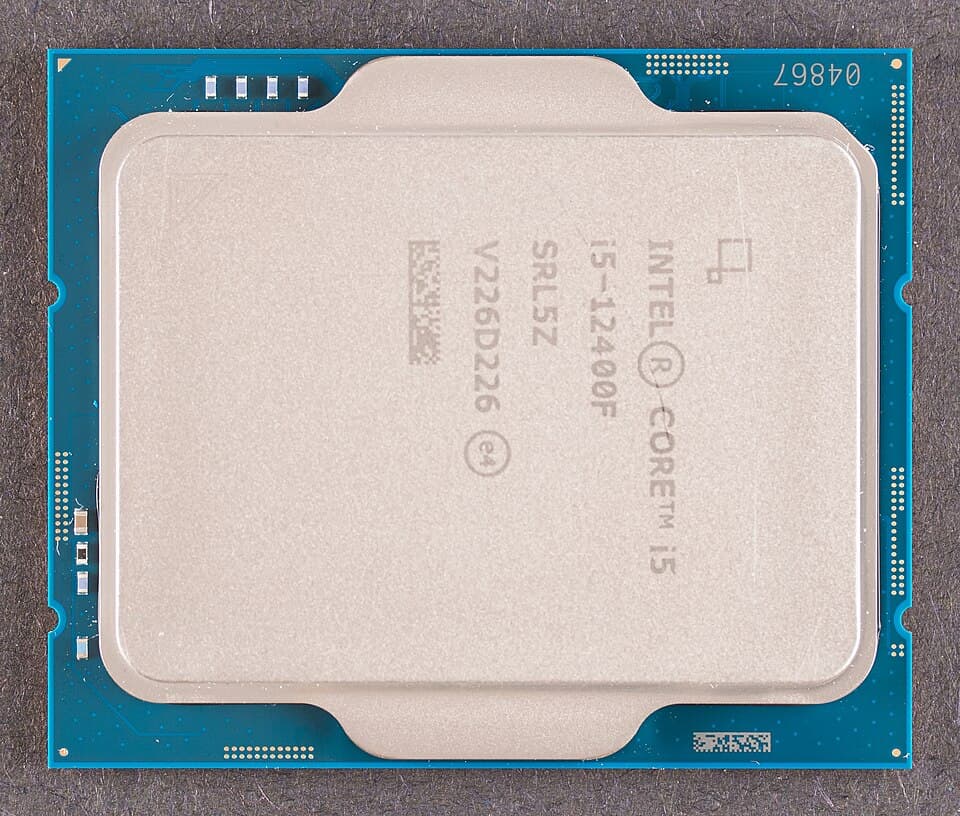
Every figure on this table is a design target. None of it is a measurement.
Nothing above describes how a processor behaves twenty minutes into a sustained workload, which is where two chips with nearly identical specifications routinely diverge. A boost clock is a ceiling the vendor permits, not a rate the chip sustains, and whether it holds depends on the cooling, the case, the power profile and the room. None of those appear on a specification sheet.
We deliberately do not reduce these figures to a single score. A composite invented from specifications would look authoritative and measure nothing, and choosing the weights would be choosing the winner.